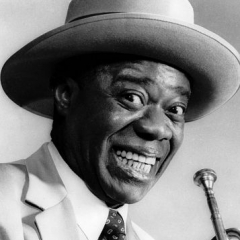


WHEN THE SAINT GO MARCHING IN
Louis Armstrong
I: We are trav'ling in the footsteps
Of those who've gone before
But we'll all be reunited (But if we stand reunited)
On a new and sunlit shore (Then a new world is in store)
D - - - / G - - - / D - - - / A - - - /
D - - - / G - - - / D - A - / D - - - //
V: O when the Saints go marching in
When the Saints go marching in
O Lord I want to be in that number
When the Saints go marching in
D - - - / / / A7 - - - / D - - - / G - - - / D - A - / D - - - //
And when the sun refuse (begins) to shine
And when the sun refuse (begins) to shine
O Lord I want to be in that number
When the Saints go marching in
When the moon turns red with blood
When the moon turns red with blood
O Lord I want to be in that number
When the Saints go marching in
On that hallelujah day
On that hallelujah day
O Lord I want to be in that number
When the Saints go marching in
O when the trumpet sounds the call
O when the trumpet sounds the call
O Lord I want to be in that number
When the Saints go marching in
B: Some say this world of trouble
Is the only one we need
But I'm waiting for that morning
When the new world is revealed
(As Intro)
V: When the revelation (revolution) comes
When the revelation (revolution) comes
O Lord I want to be in that number
When the Saints go marching in
When the rich go out and work
When the rich go out and work
O Lord I want to be in that number
When the Saints go marching in
When the air is pure and clean
When the air is pure and clean
O Lord I want to be in that number
When the Saints go marching in
When we all have food to eat
When we all have food to eat
O Lord I want to be in that number
When the Saints go marching in
When our leaders learn to cry
When our leaders learn to cry
O Lord I want to be in that number
When the Saints go marching in
Bo Peterson
Louis Daniel Armstrong, conocido como Satchmo o Pops, fue uno de los músicos de jazz estadounidenses más influyentes del siglo XX. Nacido en Nueva Orleans en 1901, Armstrong comenzó su carrera musical tocando el trombón en las calles y participando en grupos musicales locales. En 1922 se mudó a Chicago con el Hot Five de King Oliver, donde desarrolló un estilo único de trompeta caracterizado por el virtuosismo técnico y la improvisación brillante. Armstrong rápidamente se convirtió en una estrella nacional gracias a su poderosa voz y carisma en el escenario. A lo largo de su larga carrera, colaboró con numerosos artistas importantes, entre ellos Duke Ellington, Ella Fitzgerald y Billie Holiday. Entre sus canciones más famosas se encuentran "What a Wonderful World", "Hello, Dolly!" y "Stardust". Armstrong es considerado un ícono del jazz y su música sigue siendo apreciada en todo el mundo.

 Stoney Larue
 Lillie Mccloud
 Messy Marv
 Anthony Green
 Mila Mason
 Ashanti
 The Degenerates
 Eddie Cochran
 Carson Robison
 K.S. Rhoads
 Green Apple Quick Step
 Jennifer Love Hewitt